Why Duolingo Gets You to Come Back — and How We're Bringing That to Your Hardest Exams
Duolingo's real genius isn't teaching languages — it's making showing up the easiest choice. Here's the habit machine underneath it, and how MugUp points the same ingredients at the exams that actually decide your future.
Ask anyone about their learning apps and one name comes up again and again: Duolingo. People who have never stuck with any study habit in their life somehow show up for their lessons day after day. As someone building a learning tool myself, I've spent a lot of time asking: why does it work? And more importantly — why should that magic be reserved for language learning?
From what I can see, Duolingo's genius isn't really about teaching languages. It's about making showing up the easiest choice. Lessons are tiny, so "I don't have time" stops being an excuse. Progress is visible, so every session feels like it counted. Streaks make consistency itself the thing you're protecting — you come back not because you're disciplined, but because you don't want to break the chain. Add friends to the mix and there's a scoreboard giving you one more small reason to open the app tonight instead of tomorrow. The learning happens almost as a side effect of a habit that feels good.
The hardest exams get the worst experience
Meanwhile, think about how we prepare for the exams that actually decide our futures. No streaks. No small wins. No game. Just a mountain of material, a looming date, and guilt. The stakes are enormous and the experience is miserable, which is exactly backwards. The harder the exam, the more you need a system that pulls you back every single day.
That's the bet we're making with MugUp. Consistency shouldn't be a personality trait; it should be a feature of the tool. So we took the same ingredients that make a language app impossible to quit and pointed them at your hardest material.
The habit machine, aimed at your syllabus
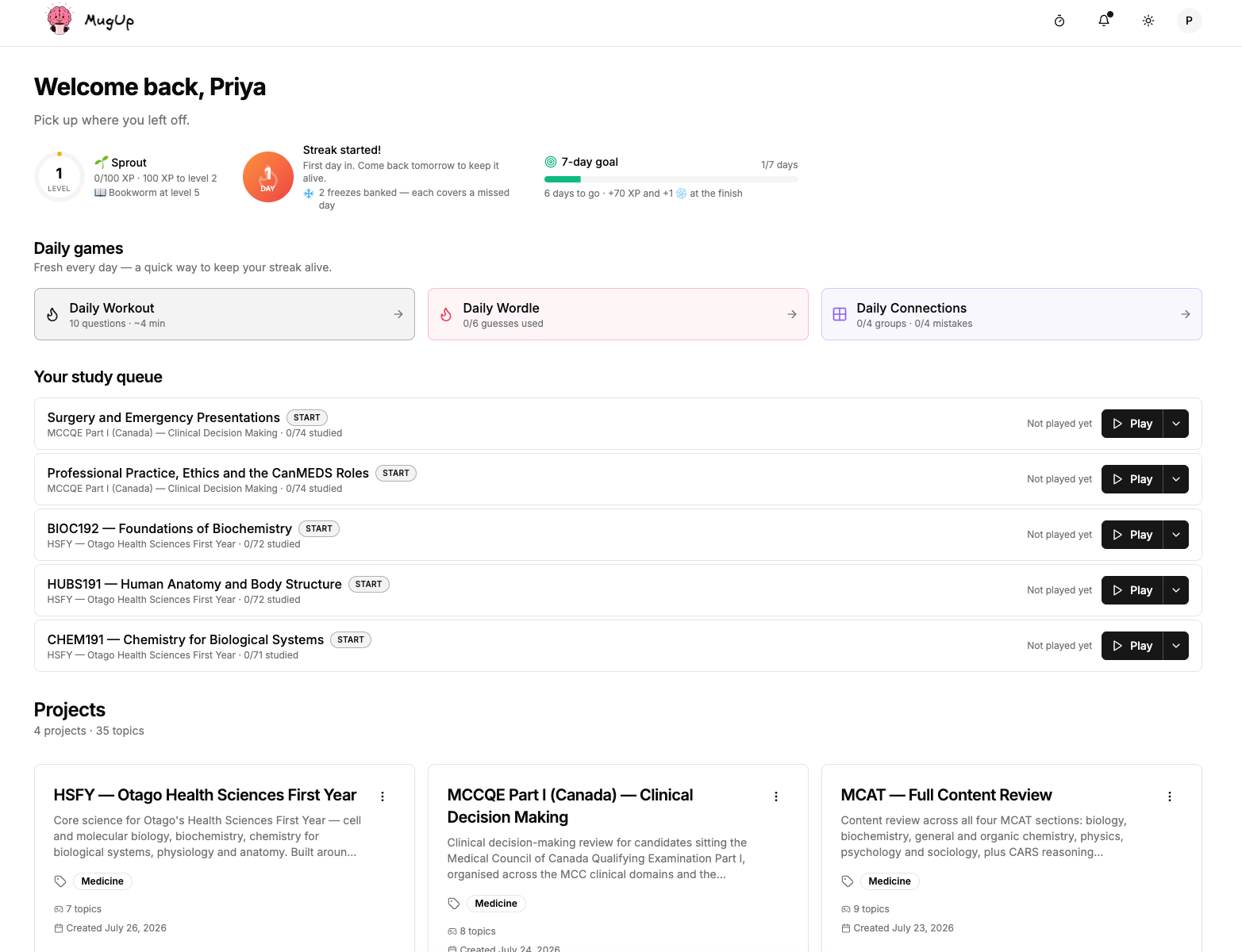
Streaks. A running day count sits at the top of your dashboard, and there are streak freezes to bank so one bad day doesn't erase two good months. It sounds small. It is the single most reliable reason people open the app on day 40, when the initial motivation is long gone.
A leaderboard with your friends on it. Follow the people you're studying alongside and you'll see them ranked by XP next to you — friends-only, or global if you want a bigger pool. Competing with strangers is abstract. Competing with the person sitting next to you in lecture is not.
Sessions short enough to actually start. You pick the size before you play — five questions, fifteen, fifty, or the whole topic — and MugUp tells you roughly how long it'll take. A two-minute round on the bus counts. Lowering the cost of starting matters more than raising the intensity of any single session.
Drills, not walls of text. Your notes become four kinds of game: multiple choice, fill-in-the-blank, flashcards, and pair match. You can also let the AI decide the mix for a topic, so a session varies instead of turning into the same drill a hundred times.
A daily workout that mixes everything together. One short session a day, three to ten questions, and you don't pick what's in it. Start it from your dashboard and it draws from every project you're studying; start it inside a project and it pulls from across all of that project's topics. So a single run jumps around — a question from last month's chapter, then something you covered yesterday, then a topic you'd half-forgotten you had. It stays interesting because it never settles into one place, and it's closer to how the real exam comes at you than an hour spent drilling one chapter in isolation. Underneath the shuffle it's still deliberate: what you've never seen and what you're about to forget come first.
Puzzles built from your own subjects. There's a Daily Wordle and a Daily Connections, generated fresh each day around what you're studying rather than generic vocabulary. It's the two minutes of fun you'd have spent on a puzzle app anyway, except now it's pulling you back toward your own material.
Under the games, the boring stuff still runs
None of this waters down the science. Every question you answer feeds a spaced-repetition schedule — the same SM-2 approach that made Anki work — so things you get wrong come back soon, things you know cold drift further out, and your review load stays sane as the pile grows. Flashcards let you rate how well you actually knew it; the other game types infer it from how you answered.
The mixing isn't just for variety either. When Rohrer and Taylor had students practise maths problems either blocked by type or shuffled together, the shuffled group did dramatically better on a later test — same problems, same total practice, different order. The catch is that mixing feels worse while you're doing it. Kornell and Bjork found that learners consistently rate blocked practice as more effective than interleaved practice, even right after taking a test that showed the opposite. Blocked practice is smoother, so it reads as progress; interleaved practice is bumpy, so it reads as struggle. Reviewers still rate interleaving as less firmly established than testing and spacing, but the direction is consistent, and it's a good reason not to let you hand-pick a comfortable session.
That's the trade we're making deliberately: keep the engine that makes recall stick, and replace the experience that makes people quit. The effort is still there. It just doesn't feel like effort.
What's next: playing against your friends live
The piece we're building now is live head-to-head. Right now the social layer is asynchronous — you see your friends' XP and their streaks, and you compete over the week. The next step is real-time: challenge a friend to the same set of questions, at the same time, and watch it play out round by round. Studying with other people already helps you remember more; making it a live match is just the most fun version of that.
Try it on the exam you're actually dreading
If prep has felt like a grind, the fix probably isn't more discipline. Take the subject you've been avoiding, turn it into a set of games, and see whether coming back tomorrow gets easier.
Start free and build your first deck today.
The takeaway
Duolingo proved that people don't lack the ability to learn consistently — they lack a system that makes coming back the path of least resistance. If a green owl can get millions of people to practice French every day, there's no reason your medical school, engineering, or professional exam prep can't work the same way. That's what we're building MugUp to be for the exams that matter most to you.
More on why this works: why learning stops being fun when we grow up and why quizzing yourself helps you remember more.
Sources
- Rohrer, D., & Taylor, K. (2007). The shuffling of mathematics problems improves learning. Instructional Science.
- Kornell, N., & Bjork, R. A. (2008). Learning Concepts and Categories: Is Spacing the "Enemy of Induction"? Psychological Science.
- Dunlosky, J., et al. (2013). Improving Students' Learning With Effective Learning Techniques. Psychological Science in the Public Interest.
- Roediger, H. L., & Karpicke, J. D. (2006). Test-Enhanced Learning: Taking Memory Tests Improves Long-Term Retention. Psychological Science.
Turn this into a game
Type a topic and MugUp's AI builds quizzes, flashcards, and matching games in seconds. Free to start.